I had a chance to read and think about the paper written by Dr. Pekka Himanen in 2004. He wrote it by request of the Committee for Future in the Parliament of Finland. He has done research work in different countries and was the youngest person to obtain a PhD in Finland. Known for his work for different levels in the Finnish public sector (as an advisor and counselor), he has also published books like "The Hacker Ethic and the Spirit of the Information Age" (2001) which focuses on fundamental ideas and questions in the current info-era.
(source: https://www.gspeakers.com/our-speakers/pekka-himanen/)
Himanen starts by explaining ten global trends that he sees strongly securing ground in society (keep in mind that the research was written in 2004):
- Increasing international tax competition
- The new global division of labor
- Population ageing
- Increasing pressures on the welfare society
- The second phase of the information society
- The rise of cultural industries
- The rise of bio-industries
- Regional concentration
- A deepening global divide
- The spread of a “culture of emergency”
In my opinion he was totally right, because almost all of these trends have happened or are close to completion in 2022. Let's take population ageing for example, most of the western countries have this problem and it's much more bigger than in 2004. In Estonia, the issue is important too, because our ageing society has less people in our workforce while they are also retiring later than they want to due to financial reasons.
He also was totally spot on with the rise of bio-industries. Our health, food, plants, animals and environment are already very popular fields that see great improvement thanks to the popularity of research and prosperity in said industry. Many humans want to perform tasks faster, feel better, look more taller and stronger, be healthier and so on - resulting in huge growth for these industries.
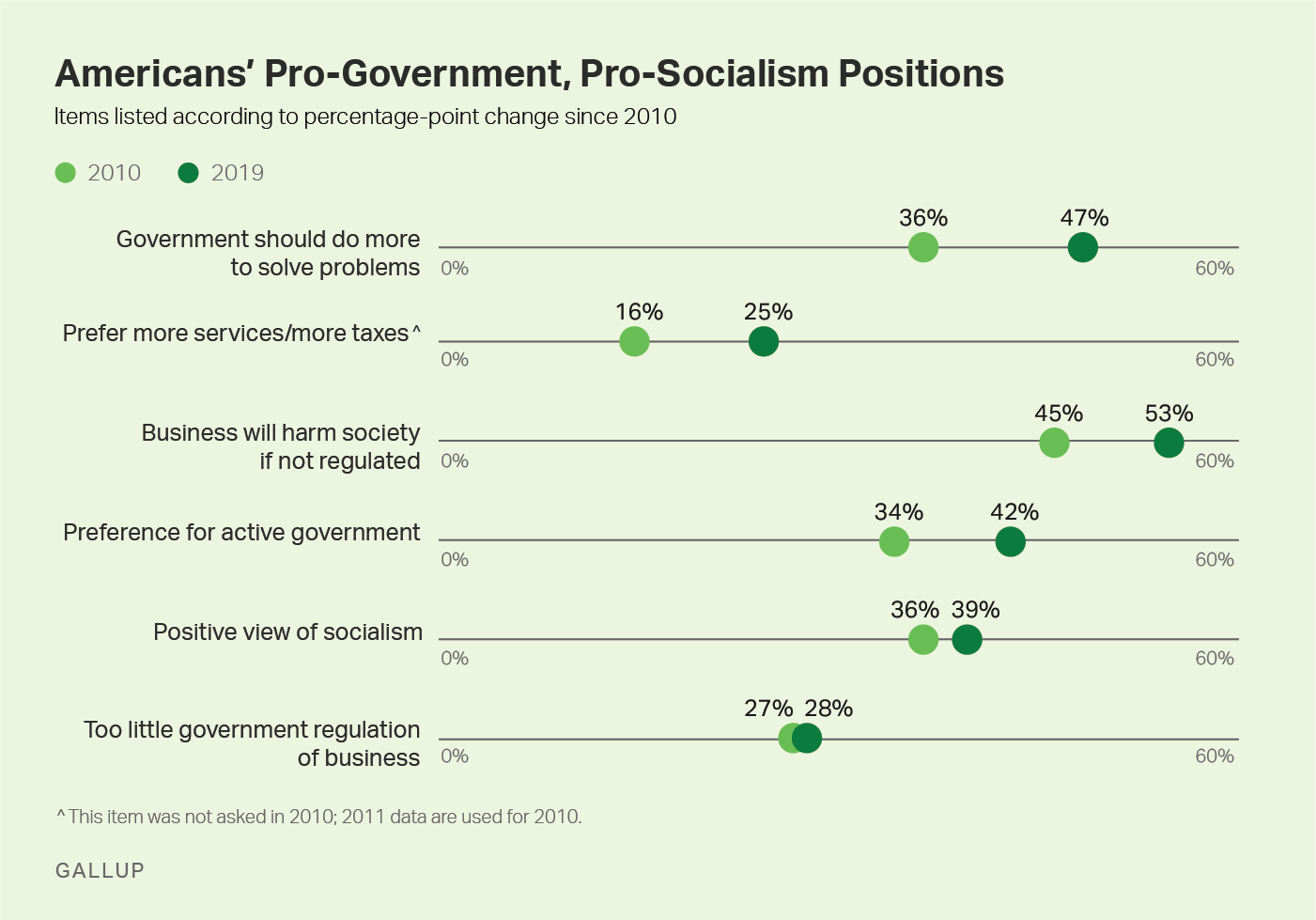
The deepening global divide is a no-brainer as well. Even the COVID crisis increased the gap between rich and poor people, creating more inequalities in the world. In my opinion, we will see this continue in our capitalistic society furthermore, because corporations have gained and will gain more power in the years to come. That could also explain why more of the younger western populations are starting to lean towards the left wing on the political compass, as they feel the need to control big firms more democratically and also gain more control and get benefits from the government.
(source: https://news.gallup.com/poll/268295/support-government-inches-not-socialism.aspx)
Dr. Himanen continues by defining three technological and economical models in three different regions:
- The American neo-liberal model - opportunities depend on the financial status of your family, the rich are getting richer while one-fifth of the population lives under the poverty line. This results in the biggest prison population (due to criminal activity to survive) in the world in California, where the upkeep of one prisoner per year costs more than an education in Harvard.
- The Asian state-run model - as other countries are reducing tax levels, production is moving to cheaper areas for businesses. This causes a huge burden on Singapore-like countries, where innovation and creativity must be a key factor to keep running a successful country consistently.
- The Finnish model - the current scenario, where the information society and welfare state are combined (with Finland being the strongest example). This model needs innovation through reforms to keep sustainability.
He follows up on some tips for the future challenge in our society. Starting with creating a more creative economy, where the difference is made with a creative approach to gain an edge. Secondly, he suggests that the welfare state needs reforms to be good for each member of society, no matter the position they were born in or are where they are in the current moment. Thirdly, he focuses on individual human development, as this is also a key factor in the future. In the last topic, he states the need of co-operation between countries and regions on a global scale to defeat problems together.
The paper by Dr. Pekka Himanen was a very interesting read for me. What impressed me the most was his ability to predict (and very accurately) the future of our society. As I pointed out before, his words were published in 2004, where the size of the IT sector was much smaller than today (just like the informational society was in its earlier stages). He is also a great writer in the sense of not just relaying boring information and data, but makes great and understandable explanations. In my opinion, his writing style reminded me of Yuval Noah Harari's work, which also explains philosophical topics on a very understandable and easy-to-read level.
Comments
Post a Comment