For most of us, not even an hour in our daytime can pass without any usage or interaction with IT systems, devices or infrastructure. From streetlights to home appliances, mobile phones to TVs, we are continuously surrounded with zeroes and ones.
Although our generation might know Information Technology as social media, smartphones and video games, the story of the digital world actually goes back decades.
Lets have a look at three interesting IT solutions created in the 20. century that have evolved into key elements in our daily life.
1. Zenith Flash-Matic (1955)
The Zenith Flash-Matic was the first wireless TV remote for the US market. It launched in 1955, when all of the TV sets had to be controlled with wired remotes, which annoyed the customers with their bulkiness and mess that they created in the living room.
Eugene Polley, an engineer for Zenith Electronics, invented the Zenith Flash-Matic, which allowed controlling the television with a pistol-like device that sent out light signals to the TV. Each corner of the TV had a special photoelectric cell, that was responsible for either volume control or channel selection. (1)
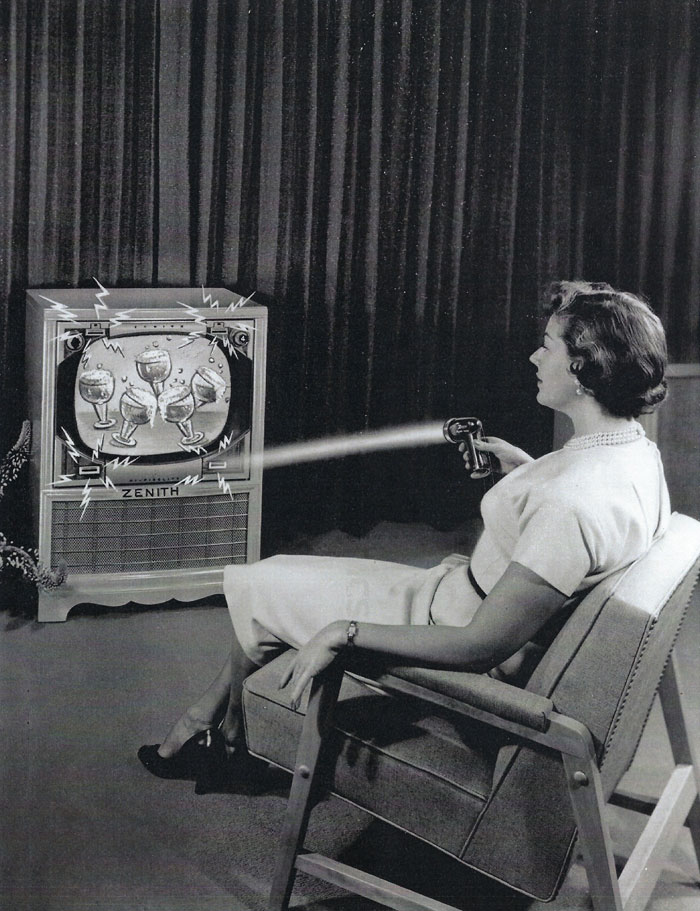
(source: https://www.earlytelevision.org/zenith_flashmatic.html)
Although this remote was a huge success with a big market demand, it had a big problem - the cells responded to all lights in the room (bulbs, candles, sunlight etc.). This encouraged Zenith to make improvements and soon newer, improved models were released. (2)
2. SABRE (1960s)
SABRE (Semi-Automatic Business Research Environment), was the first booking system, originally created for American Airlines. The idea started in 1953, when a young IBM salesman R. Blair Smith took a flight with the president of American Airlines, C.R. Smith. They talked about the inefficient paper-based system in use and the salesman promised to finish his schoolwork to start developing a better system for AA. He kept his word and after a couple of years IBM started developing a joint development with AA for a computerized booking system.

(source: http://countingthefuture.net/node/294)
By the 1960s, SABRE was the second largest real-time data system in the US, just after the government itself. They kept the leader position until launching a separate venture in 2000, just in time for the e-commerce boom. (3)
3. Portable defibrillator (1965)
The 1950s was a time with huge amounts of health failures in the western world, with people dying before even reaching the hospital or first-aid. This prompted an Irish doctor, World War 2 medic and a recipient of the Military Cross Frank Pantridge to develop a system we see everyday in ambulances, hospitals and populated public places.

(source: https://www.ncbi.nlm.nih.gov/pmc/articles/PMC555899/)
Pantridge's first defibrillator weighed 70 kilograms and required car batteries to give the electrical shock needed for the patient's heart. Later on, he developed a better and easier to operate system with a special NASA-used capacitor weighing only 3 kilograms that could save lives even when operated by people without previous medical experience. (4)
Sources used:
1. https://en.wikipedia.org/wiki/Eugene_Polley
2. https://www.earlytelevision.org/zenith_flashmatic.html
3. https://www.ibm.com/ibm/history/ibm100/us/en/icons/sabre/
4. https://www.ncbi.nlm.nih.gov/pmc/articles/PMC555899/
Comments
Post a Comment